

How to Choose Boys Black Leather Shoes for Global Buyers?
Choosing Boys Black Leather Shoes for international markets requires more than selecting a polished appearance. Buyers must examine leather quality, foot comfort, construction, sizing, and supplier consistency. A glossy upper may look impressive under showroom lighting, yet it can crease quickly after several school days. Better evaluation begins with the details: full-grain or corrected leather, breathable lining, flexible soles, secure stitching, and smooth internal seams.
Footwear biomechanics researcher Dr. Irene Davis has expressed a useful principle: “The foot is the foundation of the body.” This idea matters when assessing Boys Black Leather Shoes for growing children. A dependable pair should support natural movement without feeling rigid. The toe box needs visible space. The heel should stay stable. The outsole should bend near the forefoot, not directly beneath the arch. Small details often reveal larger quality problems.
Global buyers also need practical evidence. Request material specifications, size charts, wear-test photographs, inspection records, and consistent samples before placing large orders. Check whether black color remains even across panels. Examine loose threads, uneven edge paint, and strong chemical odors. These signs do not always prove failure, but they deserve questions. Packaging, lead times, replacement policies, and communication quality also influence purchasing risk.
There is no perfect pair.
Some buyers may overvalue appearance and underestimate comfort. Others may trust a familiar factory without reviewing current production. That can be a costly mistake. This guide explains how to compare Boys Black Leather Shoes with clearer standards, realistic expectations, and attention to children’s daily movement.
Understanding Boys’ Black Leather Shoe Types and Their Uses
How to Choose Boys Black Leather Shoes for Global Buyers?
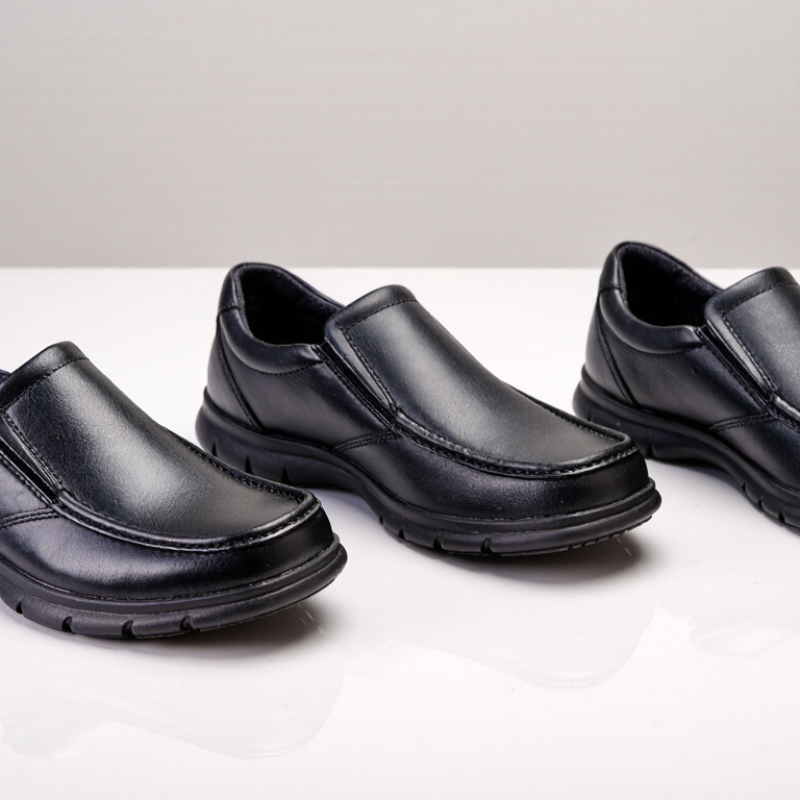
Boys’ black leather shoes differ by construction, closure, and daily purpose. School oxfords offer a neat, traditional appearance with secure lacing. They suit uniforms, ceremonies, and formal classroom settings. Derby shoes have a wider opening, helping children with higher insteps. They may feel easier to put on. Loafers provide quick wear for older boys who manage their own dressing. However, loose loafers can slip during active school days. Black leather boots add ankle support and warmth in colder regions. They work well with winter uniforms, outdoor walks, and smart-casual clothing.
Material choice affects comfort, lifespan, and care requirements. Full-grain leather usually develops a softer surface through regular use. Correctly treated split leather can also perform well at a lower price. Buyers should check the lining, stitching, heel attachment, and sole flexibility. A stiff sole may look durable but restrict natural movement. A flexible rubber sole offers grip on wet pavements and school floors. Smooth surfaces are easier to wipe clean after dusty commutes. Yet, polished leather can show scratches more clearly.
Sizing needs local research. Foot measurements vary across markets, so buyers should compare centimeters with each supplier’s chart. Leave practical toe space, not excessive room. Children’s feet grow quickly, but oversized shoes can cause rubbing and unstable steps. I have found that return planning is often overlooked. It deserves attention. Product photos also need honest details, including sole thickness, fastening style, and leather finish. A small fitting mistake can affect thousands of pairs.
How to Choose Boys Black Leather Shoes for Global Buyers? - Understanding Boys’ Black Leather Shoe Types and Their Uses
| Product Type | Typical Use | Upper Material | Closure | Outsole Characteristics | Recommended Climate | Key Comfort Features | Best Buyer Considerations |
|---|---|---|---|---|---|---|---|
| Classic School Oxford | School uniforms, formal school events, ceremonies and daily classroom wear | Corrected-grain leather or smooth full-grain leather | Lace-up | Rubber outsole with a shallow to medium tread for reliable indoor and outdoor traction | Temperate and moderately wet climates | Padded collar, cushioned footbed and rounded toe box | Check uniform requirements, leather flexibility, toe reinforcement and polishability |
| Black Derby Shoe | School uniforms and semi-formal occasions | Smooth leather or leather with a lightly textured finish | Open-lacing system | Flexible rubber or thermoplastic rubber outsole | Most climates; suitable for frequent daily use | Adjustable fit, flexible forefoot and padded tongue | Often easier to fit on wider feet than a closed-lacing Oxford |
| Boys’ Black Loafer | School uniforms, smart-casual outfits and quick changes | Leather or leather with elasticated side panels | Slip-on | Lightweight rubber outsole with moderate flexibility | Dry and temperate climates; indoor-focused use | Elastic gussets, padded insole and easy on-off construction | Confirm heel grip and instep fit to reduce slipping during walking |
| Tassel or Dress Loafer | Formal events, parties, performances and special occasions | Polished smooth leather | Slip-on | Leather-look or rubber outsole designed primarily for indoor and light outdoor use | Dry climates and occasional wear | Soft lining, padded footbed and lightweight construction | Prioritize appearance, secure heel fit and resistance to surface scuffing |
| Black Leather Ankle Boot | Cold-weather school wear, commuting and smart outdoor outfits | Full-grain leather or water-resistant treated leather | Side zip, lace-up or combined fastening | Deep rubber tread for improved grip on wet or uneven surfaces | Cool, wet and cold climates | Padded ankle collar, breathable lining and cushioned heel | Assess insulation, water resistance, zipper durability and outsole grip |
| Water-Resistant School Shoe | Daily school travel in rainy seasons and wet conditions | Coated leather or treated leather with sealed seams | Lace-up, hook-and-loop or elastic-lace system | Slip-resistant rubber outsole with a multi-directional tread | Rainy, humid and variable climates | Moisture-resistant lining, removable insole and reinforced toe | Look for tested water resistance rather than assuming all leather is waterproof |
| Hook-and-Loop Dress Shoe | Young children’s school uniforms and independent dressing | Soft leather or durable coated leather | Hook-and-loop strap | Lightweight rubber outsole with flexible forefoot grooves | Temperate and dry-to-moderately wet climates | Wide opening, padded collar and easy-adjust fastening | Useful for children who are learning to put on shoes without assistance |
| Formal Cap-Toe Shoe | Graduations, religious ceremonies, weddings and formal uniforms | Smooth full-grain or polished corrected-grain leather | Lace-up | Firm rubber outsole or leather-look sole for a neat formal profile | Dry and temperate climates | Structured heel counter, cushioned insole and smooth lining | Choose a flexible construction because children’s feet need comfortable movement |
| Wide-Fit Leather School Shoe | Daily school use for children requiring additional forefoot room | Soft full-grain leather or flexible leather | Lace-up, hook-and-loop or adjustable buckle | Flexible rubber outsole with stable heel support | Most climates, depending on lining and treatment | Roomy toe box, removable footbed and flexible upper | Measure foot length and width; avoid selecting a larger size only to gain width |
| Lightweight Uniform Sneaker-Shoe | Active school days, commuting and casual uniform policies | Leather upper combined with breathable textile panels | Lace-up or hook-and-loop | Lightweight rubber outsole with flexible traction pattern | Warm and temperate climates | Breathable lining, shock-absorbing midsole and flexible forefoot | Verify whether the school accepts athletic-style soles and mixed-material uppers |
Buyer note: Proper fit should be checked using both foot length and width. Children’s shoes should allow comfortable toe movement, secure heel placement and enough flexibility for normal walking.